


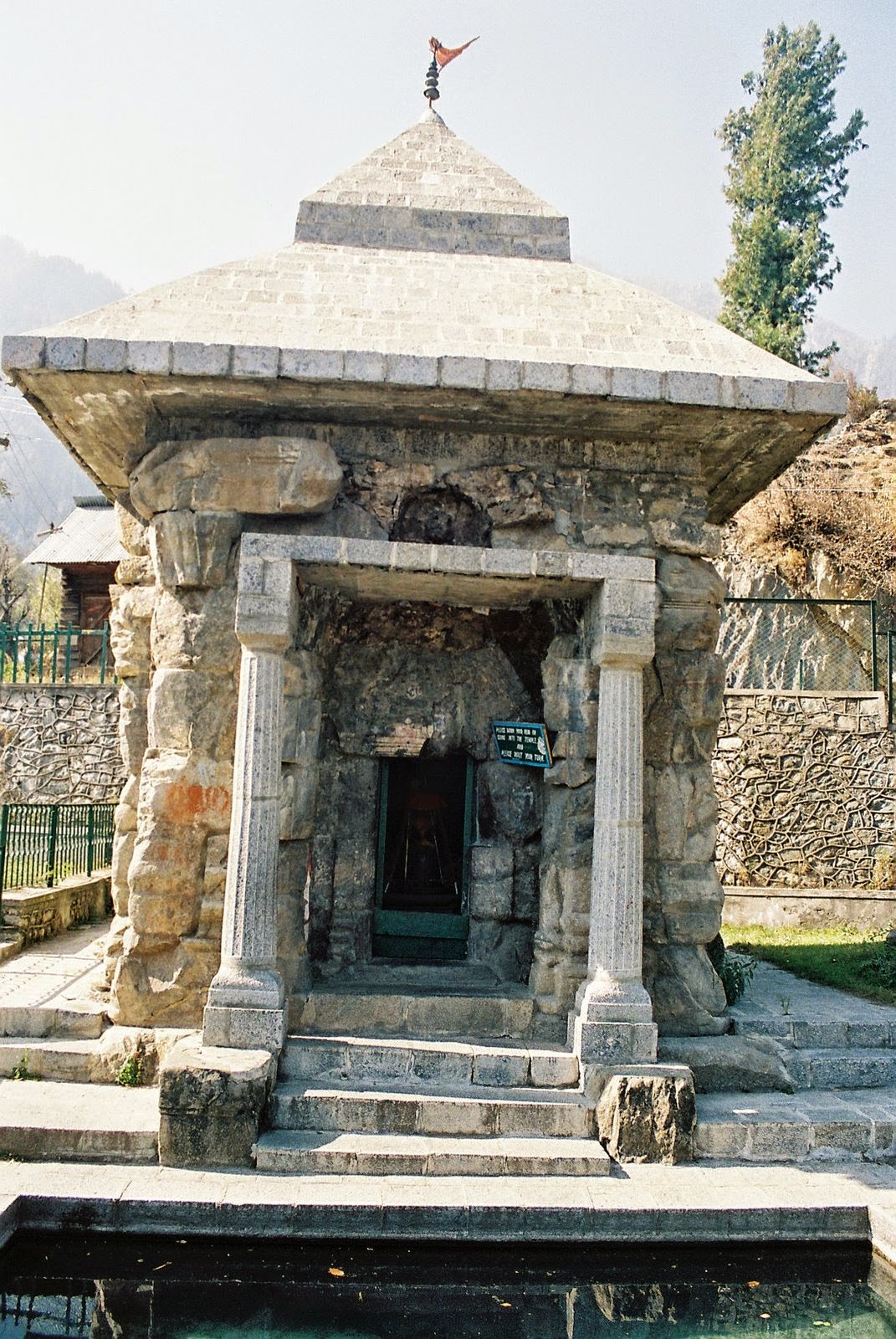
Peepal trees have the quality of propagating at high speeds i.e. if no one maintains or looks after the structure, the Peepal trees grow and a forest comes up in no time wherein the structure is lost forever.
The banyan tree has the quality of strong, deep and long roots which spread fast and if not controlled properly rip into the structure and damage the foundations. This was the self destruct means for the temple. The roots of the Banyan tree would slowly consume the structure and demolish it. The materials used were local and natural; hence when a temple was neglected and went into decay - the temple would self destruct and disappear into the wilderness. It would disintegrate and decompose over a short time and would not contribute to any kind of pollution due to the disposal of the building.
Why have we forgotten these means of responsible design today? Our life within an age of information seems so easy to gain control over; yet it has never been tougher. The world is moving towards environmental initiatives to reduce the use of energy and resources and reduce the contribution towards landfills. Have we been successful? - No, due to the lack of there being an intuitive process and design methodology; the adoption in a whole hearted manner is limited to minimal stake holders and not the entire community. New design methodologies like Leadership in Energy and Environmental Design have come up, but the costs associated with certifying buildings can sometimes be high and scares away many clients from becoming followers.
The orientation of the buildings is done to reduce the amount of energy required to heat or cool a building. For example the south and west sides have less to no windows or openings; and if any were present they were protected with overhangs or tree were planted to shelter the windows from the direct sun rays coming from the south and west sides. At the same time the north and east sides were left open and maximum light was allowed to enter the space. The North and East provided adequate sunlight without glare and minimum amount of Ultraviolet rays mixed with visible light.
Water bodies were located in the North East. At the same time the site was levelled in a way that the run off from rains would flow from other directions towards the north east. This helped the water body that was located in the north east to get replenished as well as minimized the need for a regular drainage system because the water body acted as a catchment area.
Only natural materials, cement and metal hardware was used which did not create harmful emissions of any indoor gases and helped the interior environment to be in harmony with nature; which meant a comfortable space to live and work.
 believe that the New Yorkers were one of the best audiences I have been exposed to over the past few years. They were knowledgeable and accepting to different schools of thoughts elsewhere in the world. I enjoyed every minute presenting to this wonderful audience.

 The most stable number in Vaastu was considered to be the number 8. This was due to a number of observations that were made. One of the major observations was that the human body was designed on the proportionate basis of 8 head lengths. The belief that the earth and the universe were also based on man as a unit of measurement - added to the belief that 8 was an integral number in the study of numbers.
 Most of us believe that an atom is a dense basic building component which makes up all matter. Interestingly the largest portion of an atom is just plain space or vacuum. The atom is anything but dense and compact. The position of the electrons and sub atomic particles like protons and neutrons cannot be accurately determined. There are uncertainty and probability equations such as Heisenberg's uncertainty principle which govern sub atomic particles.
  Palmistry is a great way to determine who we are and know more about others before we enter into personal or professional relationships. Ancient Japanese warrior Musashi said that the only way to win is to know our self, the competition and then determine an appropriate strategy.
1. Life Line - this line depicts the longevity and quality of life of the person, however it would not be appropriate to judge the age of a person using the length of this line. A clean line depicts an uneventful life, a broken line means changes in life or career, chained lines depict indecisiveness during that period in life and so on.
2. Heart Line - this line depicts the individuals capabilities to take decisions of a personal and emotional nature. A chained line shows difficulty in taking decisions of the heart. Also this line starts at the little finger and moves towards the index finger. The longer the line the less judgemental the individual and the shorter the line the more judgemental.
3. Head Line - this line shows education and academic achievements. It is the line of learning and even if a formal education is not achieved yet deep learning takes place, the line will be long. The longer the line is starting from the thumb side of the hand, the more the person invests in learning.
4. Marriage Lines - depict relationships of an emotional nature with persons of the opposite sex. These lines are timed starting from the heart line moving towards the little finger. If a line is present close to the heart line it depicts a relationship at an early age and if the line is towards the little finger it is a relationship at an older age.
5. Career Line - this line shows our progression in our career. It starts at the base of our palm and moves towards our fingers. Breaks in the line depict breaks or changes in our career.
One thing to always remember with palmistry is that the lines are relative to your birth conditions; hence two people with similar lines could have completely different lives. Also you read the right hand for right handed people and left for lefties. The other hand is taken as a reference point where you should have gone based on birth conditions.
Hope the above introduction to this ancient science can help as a tool to improve the quality of your personal and working relationships. We are all different and the important thing to know is that rather than assume intentions from others, we should learn to understand, work with and accept each other.


 Jyotisha or astrology is one of the oldest sciences that is used in India and means the study of light and some schools believe that the Sanskrit word derives from jyótis (disjointed as "Ja"+"Ya"+"O"+"T"+"ish" to get the root meaning as "water or birth"+"in addition to" + "earth" and "stars" + "knowledgeable" equating as one who is knowledgeable, or enlightened with knowledge, of birth, fate, and relationship to water, earth and stars) or which means "light, brightness".
The above information is inserted into a software available on a number of free web-sites like vedicscholar.com which will create a basic birth chart for you. A detailed analysis needs an expert astrologer and should not be done using online tools and web-sites.
 We all have three numbers that prove to be important in our lives.
2. Destiny Number - About our longer time luck. This is found by adding our complete date of birth to get our number. For example if you were born on the 16th of june 1971, your number is 1+6+6+1+9+7+1=31=3+1=4
3. Name Number - Our name has a number attached to it which is connected to our life. This is found by referring to the chart on the left to obtain the number attached to the alphabet. For example Sharad Mathur = 1+8+1+9+1+1+4+4+1+2+8+3+9=51=5+1=6
 The Vedic Square is one of the basic building blocks for design with Vaastu. The patterns created can be used as building ornamentation, spiritual symbols and as design elements within the landscape of a site.

 The Vaastu Purusha Manadala is one of the basic templates used in planning with Vaastu. It is a meta physical representation of a human on the site of a building.
Course Number is 4933, Subject Code 9 (Religion and Culture)
Ceu points is 0.2, 2 hours
Biography Sharad obtained an architecture degree from Bombay, started a Vaastu Consultancy in 1995 in India, and completed a MBA from Toronto specializing in Marketing in 2005. He has helped a number of clients in India and North America to design their spaces based on these principles. Sharad has spoken on invitation to IIDA and AIA audiences in North America and has demonstrated the scientific aspects of ancient sciences and their relevance in modern times.
Learning Objectives
The primary objectives of the presentation are:
1. To understand the building blocks of the ancient science of Vaastu
2. To link the principles of Vaastu to magnetism, gravity and solar radiation.
3. To understand how to use these principles to design beneficial living spaces.
Content Outline
The content follows the below mentioned format:
1. A brief history of the origin of Vaastu – mythology and reason
a. Use of PowerPoint
b. Narrative story telling
2. An explanation of the five elements that affect all spaces and living beings – fire, water, earth, ether and air
a. Power Point
b. Story telling
3. The relevance of the elements with Death
a. Story telling about Hinduism and other religions regarding death
4. Understanding solar radiation and the effect on life
a. Power Point
b. Drawing on white-board to explain infra-red and other solar radiation effects on us
5. Understanding magnetism and earths magnetic effect on buildings and living beings
a. Narrative story telling and white-board drawing
b. Power Point
6. Understanding chemistry of compounds and stable forms
a. Narrative story telling and white-board drawing
b. Power Point
7. An explanation of how to correctly take directions
a. Narrative story telling and white-board drawing
b. Power Point
8. Understanding the guidelines used when designing as per Vaastu
a. White-board drawing
b. Power Point
c. Discussion


 The story of Vaastu is 5000 years old and 12 years old in my life. I started the journey with a project in New Delhi for a large silk exporter who insisted that Vaastu was a requirement for his project. I resisted, but finally conceded to the strength of my client's convictions and belief. He had a Vaastu pundit check my work and suggest the rules required to plan effectively. The project opened my thoughts to an ancient and valuable science lost in time to the new age of scientists.
 Vaastu has changed the way I look at buildings and spaces and has helped me and many of my friends to harness the powers of nature to our advantage. Moving to Canada in 2000 strengthened my belief in the science for career prospecting to money planning activities. Today I preach the science to designers all around North America in order to increase the awareness and knowledge of this smart science.


